 Traderjoe
Traderjoe Liquidity Book uses price bins to concentrate liquidity
Traderjoe Liquidity Book is an automated market maker using fixed-price bins to concentrate liquidity. Providers choose how to allocate tokens across those bins. Each bin exchanges the pool's two tokens at one rate while its output reserves last. A larger swap can exhaust that reserve and continue at another bin's price. Providers earn fees on trading through bins in which they hold shares. Position width and distribution therefore influence earning activity, price exposure and how often liquidity needs attention.
Last updated ·
In this guide
Pool Contracts, Price Bins and Provider Shares
A Liquidity Book pool connects token reserves, a price grid and per-bin ownership balances. The pool contract, LBPair, handles swaps and liquidity changes. LBToken balances record each provider's share of individual bins. A position spanning several bins therefore consists of separate balances, each tied to liquidity at its own price. Pool-wide liquidity and a provider's position describe different amounts. Depth at the prices a swap reaches governs execution; the provider's share at those prices governs fee participation.
Traderjoe adopted the LFJ name in September 2024. Liquidity Book remains the protocol name used within that platform. Token contracts, bin step and pool version identify the relevant deployment. Multiple pools can contain the same token pair with different spacing. Positions in those pools have separate reserves and ownership records, even if their token symbols match.
Bin Steps and Price Spacing
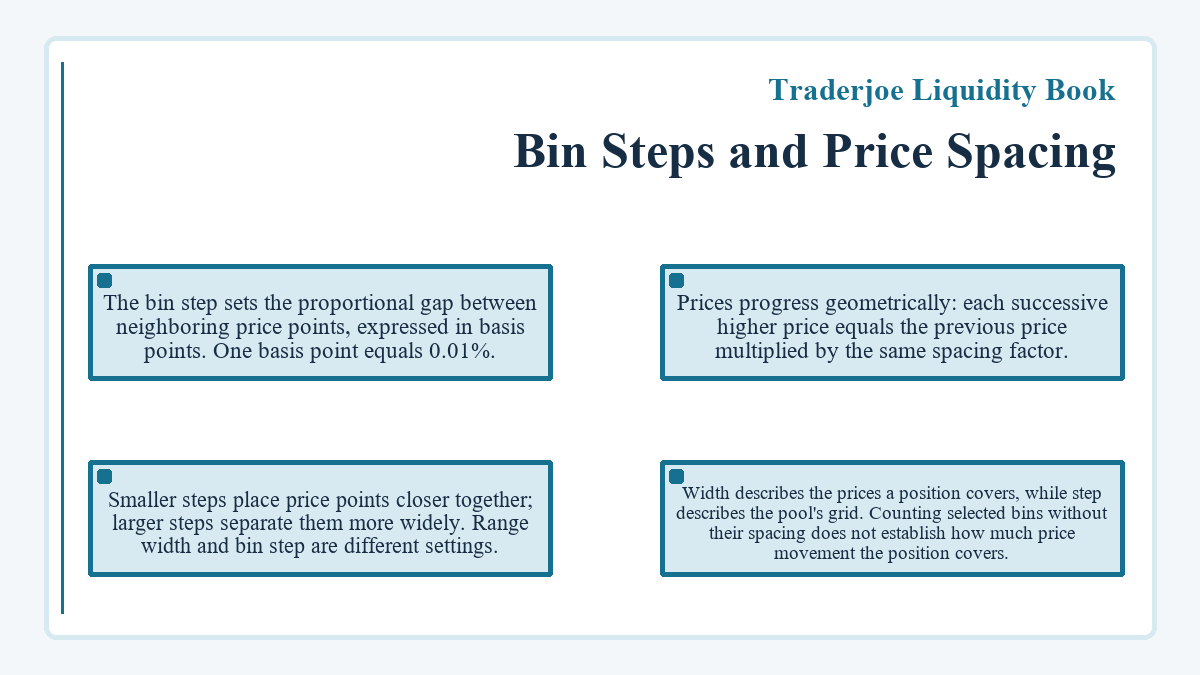
The bin step sets the proportional gap between neighboring price points, expressed in basis points. One basis point equals 0.01%. Prices progress geometrically: each successive higher price equals the previous price multiplied by the same spacing factor. Smaller steps place price points closer together; larger steps separate them more widely. Range width and bin step are different settings. Width describes the prices a position covers, while step describes the pool's grid. Counting selected bins without their spacing does not establish how much price movement the position covers.
Fixed Prices and Bin Crossings
Within a populated bin, the exchange rate stays constant as a swap changes its reserves.
Liquidity Book uses a constant-sum invariant within each price bin.
With consistently denominated token quantities, P × x + y = L relates reserves to liquidity at price P. Here, x and y are token quantities, with P expressing units of token Y per token X.
Once a swap consumes the available output token, additional input needs another populated bin. Empty price points supply no trading depth. The next usable bin may sit beyond a gap in liquidity, producing a larger price jump. Total pool reserves cannot show how much output remains available at the initial fixed price.
Zero price movement within a bin does not remove swap fees or protect a quote from intervening trades. Price impact across bins and execution slippage remain separate considerations.
Single-Sided Reserves and the Active Bin
Bin composition follows its position relative to the active price, with prices expressed as token Y per token X. Below the active price, populated bins hold token Y; above it, they hold token X. The active bin is the one bin able to hold both. Its reserves change as trades convert one token into the other.
| Bin Position | Token Reserves |
|---|---|
| Below the active price | Only token Y in populated bins |
| At the active price | Can hold both token X and token Y |
| Above the active price | Only token X in populated bins |
A single-sided deposit supplies one token to eligible bins. This can include the active bin, where the minted shares can represent both assets and a composition fee can apply. It begins earning swap fees when trades reach those bins. Conversion can change the position into the other token, partly or completely. Bin liquidity remains available for later trading after conversion; its token balance can change again if the price reverses.
Liquidity Shapes Within a Chosen Range
Liquidity shapes control how much capital occupies each selected price point. Spot distributes liquidity uniformly across its chosen range. Curve places more near a central price while retaining liquidity in surrounding bins. Bid-Ask aims to capture trading as prices fluctuate within its deployed range. These choices alter the allocation inside a range; they do not set a universal earning rate. A broad selection of bins with little capital near the active price can provide less immediate depth than a tighter allocation. No shape prevents impermanent loss.
Base Fees and the Volatility Accumulator
Swap fees combine a base component with a variable component linked to the pool's volatility accumulator. The base fee uses the pool's bin step and configured base factor. The variable fee responds to recent bin movement, using parameters controlling its strength and persistence. A zero variable-fee control disables the variable component. Pool-specific settings mean a single fee percentage cannot describe every Liquidity Book market or every trade through one market.
Bin crossings can update the variable fee during a swap, so separate portions may face different rates. Time between swaps also affects the retained volatility reference. The protocol uses filter and decay parameters to preserve, reduce or reset that reference. Rapid trading alone does not imply the same fee movement in every direction. The accumulator also depends on movement relative to its reference bin.
Fees accrue to the bins a trade uses, proportional to provider shares after any configured protocol deduction. Additional fees can offset losses; they do not guarantee a positive return.
Range Width, Fee Share and Impermanent Loss
Concentration increases capital available at selected prices, but it also changes how quickly a position's token mix can shift. Trades progressively exchange the reserves in each participating bin. A move through the deposited range can leave the position entirely in one token. Impermanent loss measures the shortfall against holding the same deposited tokens, before counting fees. That comparison needs the same starting quantities and a common valuation point. Merely seeing a larger token balance does not establish a gain.
Range width spreads capital over more or fewer price points. For the same total capital and a uniform allocation, covering more bins reduces the amount at each point. A narrow range increases reliance on the price staying near that allocation. Fee income, changing asset prices and rebalancing costs all affect the outcome. A position can earn fees during trading and still finish below the value of simply holding its initial assets.
Deposit Placement and Execution Limits
Deposit parameters specify an intended active bin, permitted bin movement and minimum accepted token amounts. The active price can move between preparing a transaction and executing it, so the router checks permitted movement before placing liquidity. Deposits use bin positions relative to the active bin, so a shifted reference can change the prices receiving the allocation. Token amount limits and bin-movement limits protect different parts of that instruction. The router rejects a deposit if actual added amounts fall below either specified minimum. An execution deadline also bounds how late the instruction can run.
Allocation must also respect which token each bin can accept. Depositing token X below the active bin or token Y above it causes a revert. A movement beyond the permitted bin tolerance also causes a revert. Loosening tolerance changes acceptable placement without preserving the originally selected prices. Deposit parameters also set how much of each token goes into each chosen bin. Undistributed amounts go to the refund recipient.
Refunded excess tokens remain outside the deposited position. Minted bin shares record accepted liquidity; granting a spending approval alone does not establish any deposited balance.
Rebalancing Costs and Waiting Out a Price Move
Rebalancing moves existing liquidity from inactive prices toward a different allocation. Rebalancing withdraws the affected liquidity for redeployment; preparing a different token mix before redepositing can require swaps. Those operations introduce network costs and, where swaps occur, trading fees. Waiting leaves the original bins in place; they can earn again if trading returns. Adding liquidity near the active price uses extra capital without relocating the earlier position. Automatic fee accrual does not perform these reallocations. The choice changes which prices the capital serves and whether the position carries additional token exposure.
Accrued Fees and Withdrawal Amounts
Withdrawal redeems bin shares for their proportional claim on the reserves the selected bins currently hold. Trading can change those reserves after the original deposit. The returned token quantities therefore need not match the deposited quantities. In V2.1 and V2.2, provider swap fees join bin reserves, increasing the underlying assets represented by existing shares. That accrual stays with the bins earning it; it does not follow the active price into another bin.
V2.0 handled fees separately, so fee collection differs from later pools. Withdrawal also needs a router compatible with the pool version. Removing selected bins leaves other bin balances in place. Returned assets are no longer supplied to the pool; remaining shares represent claims on their bins' current reserves.
What readers ask about Traderjoe Liquidity Book
Can I Transfer My Liquidity Book Bin Shares to Another Wallet?
LBToken supports transfers of bin-share balances between wallets. Each transferred balance carries ownership of the corresponding pool liquidity, so the recipient receives the associated reserve claim. These custom multi-token receipts resemble ERC-1155 but omit its receiver callbacks. Wallet or application support for standard ERC-1155 tokens alone does not establish support for LBToken transfers.
Why Can Adding Liquidity to the Active Bin Charge a Composition Fee?
An active-bin deposit can incur a composition fee when its token proportions differ from the bin's existing reserves. That mismatch creates an implicit exchange within the deposit. The fee accounts for this exchange when calculating the shares minted. The rule applies to composition changes within the active bin.
Which Router Handles Withdrawals From Older Liquidity Book Pools?
Older Liquidity Book pools require a router compatible with their own version for liquidity removal. V2.0 pools use the V2.0 router and V2.1 pools use the V2.1 router. The V2.2 router does not support V2.1 liquidity management, even though the interface can appear similar. Swap-route compatibility does not establish withdrawal compatibility.
Does a Liquidity Book Quote With Unspent Input Confirm a Full Swap?
A quote reporting unspent input does not confirm the full input can execute through that pool. The getSwapOut calculation reports amountInLeft when available liquidity cannot consume all the proposed input. Its amountOut describes output for the portion the calculation could process. It is a simulation result, not evidence of an executed partial swap.
How Do I Convert a Liquidity Book Bin Price Into a Displayed Token Price?
For V2.2 contract prices, divide the 128.128 fixed-point value by 2^128 and adjust for both tokens' decimals. Multiply the decoded ratio by 10^(decimalsX - decimalsY) to express token Y per token X. Equal token-decimal counts need no additional scaling, although the fixed-point decoding still applies. Reversing token order changes the price quotation.